
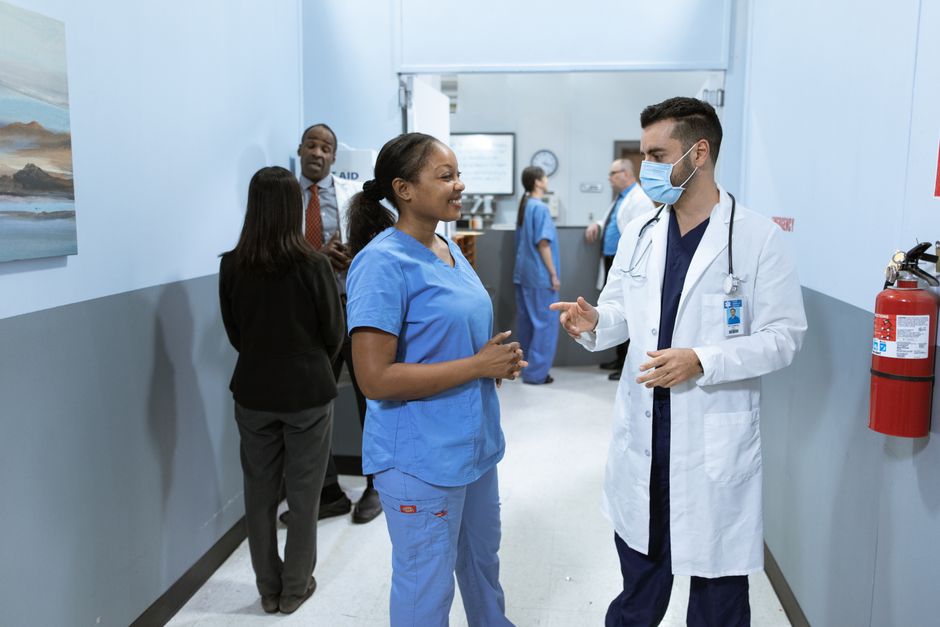

En mai 2020, une enquête américaine en ligne a évalué la santé mentale de 1 092 professionnels de santé pendant les premières semaines de la pandémie. Les chercheurs ont utilisé des questionnaires de dépistage pour repérer une dépression majeure probable, une anxiété généralisée, un état de stress post-traumatique et un trouble de l’usage de l’alcool.
Les résultats dépassaient les seuils retenus pour une dépression majeure probable chez 13,9 % des participants, une anxiété généralisée chez 15,6 %, un état de stress post-traumatique chez 22,8 % et un trouble de l’usage de l’alcool chez 42,8 %. L’échantillon comptait 72 % de femmes, 51,9 % de professionnels travaillant en première ligne et l’âge moyen était de 40,4 ans.
Un score de dépistage n’est pas un diagnostic. Il indique qu’une évaluation plus complète peut être nécessaire. La détresse observée dépend aussi du soutien socialde l’équipe, des règles de l’établissement et de la stigmatisation.
Le cadre de travail compte.
Des scores élevés, sans diagnostic automatique
L’étude américaine, publiée dans PLOS ONEétait transversale : les participants ont répondu au questionnaire pendant le mois de mai 2020. Les pourcentages décrivent donc une situation observée à ce moment précis, dans un contexte de surcharge et d’incertitude.
Au Royaume-Uni, une étude publiée dans Occupational and Environmental Medicine a recueilli entre avril et juin 2020 les réponses de 4 378 professionnels cliniques et non cliniques de trois établissements du NHS à Londres. Les chercheurs ont relevé 58,9 % de troubles mentaux courants probables, 30,2 % de symptômes compatibles avec un état de stress post-traumatique, 27,3 % de dépression probable et 23,2 % d’anxiété probable. Le mésusage de l’alcool concernait 10,5 % des participants.
Quand le risque sort de la tête
L’étude américaine ne s’intéressait pas uniquement aux caractéristiques individuelles. Elle examinait quatre niveaux de facteurs : individuel, interpersonnel, institutionnel et communautaire. Le questionnaire portait notamment sur le soutien social, la disponibilité des équipements de protection et la stigmatisation des professionnels de santé.
Le besoin de davantage de soutien social était associé à une probabilité plus élevée de dépression majeure probable, d’anxiété généralisée et d’état de stress post-traumatique. Cette association ne prouve pas que le manque de soutien provoque seul ces troubles. Une personne déjà en difficulté peut aussi demander davantage d’aide.
Au Royaume-Uni, les chercheurs ont également mesuré la blessure morale avec la Moray Injury Event Scale. Cette mesure distingue une détresse liée à des événements vécus comme contraires aux valeurs des seuls symptômes repérés par les questionnaires. Elle rappelle qu’une situation de travail peut peser par sa charge, mais aussi par le sens que le professionnel lui donne.
Une écoute individuelle peut aider. Elle ne modifie pas, à elle seule, les horaires, les consignes, les moyens disponibles ou la manière dont une équipe répond à une alerte.
Le temps ne suffit pas toujours
Une large enquête longitudinale espagnole, publiée dans Epidemiology and Psychiatric Sciencesajoute une dimension absente d’une enquête menée à un seul moment. Les chercheurs ont suivi les participants dans le temps au lieu de dresser une photographie unique de leur état psychique.
Ce type de suivi permet d’observer la persistance ou l’évolution des symptômes chez les mêmes personnes. Il ne démontre pas, à lui seul, qu’un facteur précis a causé un trouble. Il permet toutefois de poser une question concrète : les difficultés diminuent-elles quand l’urgence recule, ou restent-elles présentes après la période la plus intense?
Cette distinction compte pour l’accompagnement. Une organisation peut répondre à une crise immédiate et laisser subsister, après coup, une fatigue, une culpabilité ou une difficulté à reprendre le rythme habituel.
L’alcool demande une lecture prudente
Au Kenya, une étude transversale menée au début de la pandémie a analysé les réponses de 887 professionnels de santé ayant rempli le questionnaire AUDIT. Parmi eux, 389, soit 43,9 %, ont atteint le seuil retenu pour un usage nocif de l’alcool.
Ce résultat décrit cet échantillon à une période donnée. Il ne permet ni d’estimer la situation de tous les soignants ni d’affirmer que la pandémie a provoqué chaque consommation. Le questionnaire repère un niveau de risque; il ne remplace pas un entretien d’addictologie ou une évaluation médicale.
Une consommation qui augmente, devient solitaire ou sert à dormir, tenir une garde ou faire taire des images pénibles mérite un échange avec un médecin, un professionnel de l’addictologie ou le service de santé au travail. Attendre que la consommation règle elle-même le problème laisse souvent le mécanisme s’installer.
Réparer l’aide, pas seulement proposer une écoute

Pour un soignant, une consultation peut se justifier lorsque le sommeil reste perturbé, que des souvenirs s’imposent, que l’anxiété devient difficile à contenir, que le travail est évité ou que la consommation augmente. Le médecin traitant, le médecin du travail, un psychologue, un psychiatre ou une structure spécialisée peuvent constituer une première porte d’entrée.
Pour les établissements, les réponses doivent aussi toucher l’organisation : des informations compréhensibles, des espaces confidentiels, un soutien social accessible et une protection contre la stigmatisation. La cohésion d’équipe se vérifie dans les transmissions, les décisions prises sous pression et la manière dont un encadrant accueille une difficulté.
La psychologie positive peut aider à identifier les ressources d’une personne et d’un groupe. Elle ne devrait pas transformer une exposition prolongée en preuve de courage. La résilience aide à traverser une épreuve; elle ne compense pas seule une organisation qui laisse les contraintes intactes.
La résilience ne remplace pas la protection.
Sources et références scientifiques
- Socio-ecological predictors of mental health outcomes among healthcare workers during the COVID-19 pandemic in the United States – PMC. PloS one. DOI: 10.1371/journal.pone.0246602 · PMID: 33544761.
- 1.Centers for Disease Control and Prevention. Coronavirus Disease 2019 (COVID-19): Cases, Data, and Surveillance 2020. Available from:.
- 2.Pappa S, Ntella V, Giannakas T, Giannakoulis VG, Papoutsi E, Katsaounou P. Prevalence of depression, anxiety, and insomnia among healthcare workers during the COVID-19 pandemic: A systematic review and meta-analysis. Brain Behav Immun. 2020. [DOI] [PMC free article] [PubMed] [Google Scholar].
- barkapa S, Nadjidai SE, Murgier J, Ng CH. The psychological impact of COVID-19 and other viral epidemics on frontline healthcare workers and ways to address it: A rapid systematic review. Brain Behav Immun Health. 2020:100144 10.1016/j.bbih.2020.100144 [DOI] [PMC free article] [PubMed] [Google Scholar]. doi:10.1016/j.bbih.2020.100144.
- 4.Shechter A, Diaz F, Moise N, Anstey DE, Ye S, Agarwal S, et al. Psychological distress, coping behaviors, and preferences for support among New York healthcare workers during the COVID-19 pandemic. Gen Hosp Psychiatry. 2020;66:1-8. 10.1016/j.genhosppsych.2020.06.007 [DOI] [PMC free article] [PubMed] [Google Scholar]. doi:10.1016/j.genhosppsych.2020.06.007.
- 5.Sallis JF, Owen N, Fisher EB. Ecological models of health behavior Health behavior and health education: theory, research, and practice. San Francisco: Jossey-Bass; 2008. [Google Scholar].
- 6.Centers for Disease Control and Prevention. The Social-Ecological Model: A Framework for Prevention [October 15, 2020]. Available from:.
- 7.Bronfenbrenner U. Toward an experimental ecology of human development. American Psychologist. 1977;32(7):513-31. [Google Scholar].
- 8.Lai J, Ma S, Wang Y, Cai Z, Hu J, Wei N, et al. Factors Associated With Mental Health Outcomes Among Health Care Workers Exposed to Coronavirus Disease 2019. JAMA Netw Open. 2020;3(3):e203976 10.1001/jamanetworkopen.2020.3976 [DOI] [PMC free article] [PubMed] [Google Scholar]. doi:10.1001/jamanetworkopen.2020.3976.
- 9.Juan Y, Yuanyuan C, Qiuxiang Y, Cong L, Xiaofeng L, Yundong Z, et al. Psychological distress surveillance and related impact analysis of hospital staff during the COVID-19 epidemic in Chongqing, China. Comprehensive Psychiatry. 2020;103 10.1016/ppsych.2020.152198 [DOI] [PMC free article] [PubMed] [Google Scholar]. doi:10.1016/j.comppsych.2020.152198.
- 10.Rossi R, Socci V, Pacitti F, DiLorenzo G, DiMarco A, Siracusano A, et al. Mental Health Outcomes Among Frontline and Second-Line Health Care Workers During the Coronavirus Disease 2019 (COVID-19) Pandemic in Italy. JAMA Netw Open. 2020;3(5):e2010185 10.1001/jamanetworkopen.2020.10185 [DOI] [PMC free article] [PubMed] [Google Scholar]. doi:10.1001/jamanetworkopen.2020.10185.
- 11.Evanoff BA, Strickland JR, Dale AM, Hayibor L, Page E, Duncan JG, et al. Work-Related and Personal Factors Associated With Mental Well-Being During the COVID-19 Response: Survey of Health Care and Other Workers. J Med Internet Res. 2020;22(6). 10.2196/21366 [DOI] [PMC free article] [PubMed] [Google Scholar]. doi:10.2196/21366.
- 12.Xiao H, Zhang Y, Kong D, Li S, Yang N. The effects of social support on sleep quality of medical staff treating patients with coronavirus disease 2019 (COVID-19) in January and February 2020 in China. Med Sci Monit. 2020;26:e923549 10.12659/MSM.923549 [DOI] [PMC free article] [PubMed] [Google Scholar]. doi:10.12659/MSM.923549.
- Psychosocial impact of the COVID-19 pandemic on 4378 UK healthcare workers and ancillary staff: initial baseline data from a cohort study collected during the first wave of the pandemic – PMC. Occupational and environmental medicine. DOI: 10.1136/oemed-2020-107276 · PMID: 34183447.
- 1. Williamson V, Stevelink SAM, Greenberg N. Occupational moral injury and mental health: systematic review and meta-analysis. Br J Psychiatry 2018;212:339-46. 10.1192/bjp.2018.55 [DOI] [PubMed] [Google Scholar]. doi:10.1192/bjp.2018.55.
- 2. Brooks SK, Dunn R, Amlôt R, et al. A systematic, thematic review of social and occupational factors associated with psychological outcomes in healthcare employees during an infectious disease outbreak. J Occup Environ Med 2018;60:248-57. 10.1097/JOM.0000000000001235 [DOI] [PubMed] [Google Scholar]. doi:10.1097/JOM.0000000000001235.
- 3. Lung F-W, Lu Y-C, Chang Y-Y, et al. Mental symptoms in different health professionals during the SARS attack: a follow-up study. Psychiatr Q 2009;80:107-16. 10.1007/s11126-009-9095-5 [DOI] [PubMed] [Google Scholar]. doi:10.1007/s11126-009-9095-5.
- 4. Wu P, Fang Y, Guan Z, et al. The psychological impact of the SARS epidemic on hospital employees in China: exposure, risk perception, and altruistic acceptance of risk. Can J Psychiatry 2009;54:302-11. 10.1177/070674370905400504 [DOI] [PMC free article] [PubMed] [Google Scholar]. doi:10.1177/070674370905400504.
- 5. Daly M, Sutin A, Robinson E. Longitudinal changes in mental health and the COVID-19 pandemic: Evidence from the UK Household Longitudinal Study [Internet]. PsyArXiv 2020. [DOI] [PMC free article] [PubMed] [Google Scholar].
- 6. Fancourt D, Steptoe A, Bu F. Trajectories of depression and anxiety during enforced isolation due to COVID-19: longitudinal analyses of 59,318 adults in the UK with and without diagnosed mental illness. medRxiv 2020. [Google Scholar].
- 7. Pierce M, Hope H, Ford T, et al. Mental health before and during the COVID-19 pandemic: a longitudinal probability sample survey of the UK population. Lancet Psychiatry 2020;7:883-92. 10.1016/S2215-0366(20)30308-4 [DOI] [PMC free article] [PubMed] [Google Scholar]. doi:10.1016/S2215-0366(20)30308-4.
- 8. Pierce M, McManus S, Jessop C, et al. Says who? the significance of sampling in mental health surveys during COVID-19. Lancet Psychiatry 2020;7:567-8. 10.1016/S2215-0366(20)30237-6 [DOI] [PMC free article] [PubMed] [Google Scholar]. doi:10.1016/S2215-0366(20)30237-6.
- 9.. Office for National Statistics. Death registrations and occurrences by local authority and health board. U: Office for National Statistics; 2020. [Accessed 29/11/20]. [Google Scholar].
- 10. Goldberg DP, Hillier VF. A scaled version of the general health questionnaire. Psychol Med 1979;9:139-45. 10.1017/S0033291700021644 [DOI] [PubMed] [Google Scholar]. doi:10.1017/S0033291700021644.
- 11. Spitzer RL, Kroenke K, Williams JBW, et al. A brief measure for assessing generalized anxiety disorder: the GAD-7. Arch Intern Med 2006;166:1092-7. 10.1001/archinte.166.10.1092 [DOI] [PubMed] [Google Scholar]. doi:10.1001/archinte.166.10.1092.
- 12. Kroenke K, Spitzer RL, Williams JBW. The PHQ-9. J Gen Intern Med 2001;16:606-13. 10.1046/j.1525-1497.2001.016009606.x [DOI] [PMC free article] [PubMed] [Google Scholar]. doi:10.1046/j.1525-1497.2001.016009606.x.
- Mental impact of Covid-19 among Spanish healthcare workers. A large longitudinal survey – PMC. Epidemiology and psychiatric sciences. DOI: 10.1017/s2045796022000130 · PMID: 35485802.
- Alonso J, Vilagut G, Mortier P, Ferrer M, Alayo I, Aragon-Peña A, Aragones E, Campos M, Cura-Gonzalez ID, Emparanza JI, Espuga M, Forjaz MJ, Gonzalez-Pinto A, Haro JM, Lopez-Fresneña N, Salazar ADM, Molina JD, Orti-Lucas RM, Parellada M, Pelayo-Teran JM, Perez-Zapata A, Pijoan JI, Plana N, Puig MT, Rius C, Rodriguez-Blazquez C, Sanz F, Serra C, Kessler RC, Bruffaerts R, Vieta E and Perez-Sola V and MINDCOVID Working Group (2021) Mental health impact of the first wave of COVID-19 pandemic on Span.
- Barroilhet S, Cano-Prous A, Cervera-Enguix S, Forjaz MJ and Guillen-Grima F (2009) A Spanish version of the family assessment device. Social Psychiatry and Psychiatric Epidemiology 44, 1051-1065. [DOI] [PubMed] [Google Scholar].
- Berry JO and Jones WH (1995) The parental stress scale: initial psychometric evidence. Journal of Social and Personal Relationship 12, 463-472. [Google Scholar].
- Blasco MJ, Castellvi P, Almenara J, Lagares C, Roca M, Sese A, Piqueras JA, Soto-Sanz V, Rodriguez-Marin J, Echeburua E, Gabilondo A, Cebria AI, Miranda-Mendizabal A, Vilagut G, Bruffaerts R, Auerbach RP, Kessler RC and Alonso J and Universal Study Group (2016) Predictive models for suicidal thoughts and behaviors among Spanish University students: rationale and methods of the UNIVERSAL (University & mental health) project. BMC Psychiatry 16, 122. [DOI] [PMC free article] [PubMed] [Google Schola.
- Boden M, Cohen N, Froelich JM, Hoggatt KJ, Abdel Magid HS and Mushiana SS (2021a) Mental disorder prevalence among populations impacted by coronavirus pandemics: a multilevel meta-analytic study of COVID-19, MERS & SARS. General Hospital Psychiatry 70, 124-133. [DOI] [PMC free article] [PubMed] [Google Scholar].
- Boden M, Zimmerman L, Azevedo KJ, Ruzek JI, Gala S, Abdel Magid HS, Cohen N, Walser R, Mahtani ND, Hoggatt KJ and McLean CP (2021b) Addressing the mental health impact of COVID-19 through population health. Clinical Psychology Review 85, 102006. [DOI] [PMC free article] [PubMed] [Google Scholar].
- Chigwedere OC, Sadath A, Kabir Z and Arensman E (2021) The impact of epidemics and pandemics on the mental health of healthcare workers: a systematic review. International Journal of Environmental Research and Public Health 18, 6695. [DOI] [PMC free article] [PubMed] [Google Scholar].
- Daly M and Robinson E (2021) Acute and longer-term psychological distress associated with testing positive for COVID-19: longitudinal evidence from a population-based study of US adults. Psychological Medicine, 1-8, [Epub ahead of print]. doi: 10.1017/S003329172100324X. [DOI] [PMC free article] [PubMed] [Google Scholar]. doi:10.1017/S003329172100324X.
- de Kock JH, Latham HA, Leslie SJ, Grindle M, Muñoz SA, Ellis L, Polson R and O'Malley CM (2021) A rapid review of the impact of COVID-19 on the mental health of healthcare workers: implications for supporting psychological well-being. BMC Public Health 21, 104. [DOI] [PMC free article] [PubMed] [Google Scholar].
- Diez Martinez S, Martin Moros JM, Altisent Trota R, Aznar Tejero P, Cebrian Martin C, Imaz Perez FJ and del Castillo Pardo M (1991) Brief questionnaires for the early detection of alcoholism in primary health care. Atencion Primaria 8, 367-370. [PubMed] [Google Scholar].
- Dohrenwend BS, Krasnoff L, Askenasy AR and Dohrenwend BP (1978) Exemplification of a method for scaling life events: the peri life events scale. Journal of Health and Social Behavior 19, 205-229. [PubMed] [Google Scholar].
- Drissi N, Ouhbi S, Marques G, de la Torre Diez I, Ghogho M and Janati Idrissi MA (2021) A systematic literature review on e-mental health solutions to assist health care workers during COVID-19. Telemedicine Journal and e-Health 27, 594-602. [DOI] [PubMed] [Google Scholar].
- Harmful Alcohol Use Among Healthcare Workers at the Beginning of the COVID-19 Pandemic in Kenya – PMC. Frontiers in psychiatry. DOI: 10.3389/fpsyt.2022.821610 · PMID: 35295779.
- 1.World Health Organization. Health workforce policy and management in the context of the COVID-19 pandemic response: interim guidance. World Heal Organ [Internet]. (2020), pp. 1-34. Available online at:.
- 2.World Health Organization. Coronavirus Disease (Covid-19) Outbreak: Rights, Roles and Responsibilities of Health Workers, Including Key Considerations for Occupational Safety. World Heal Organ [Internet]. (2019), pp. 1-3. Available online at:.
- 3.Mulaki A, Muchiri S. Kenya Health System Assessment. (2019), pp. 1-123. [Google Scholar].
- 4.Resources H, Observer H, No S. Health workforce requirements for universal health coverage and the Sustainable Development Goals. (2016), p. 17. Available online at:.
- barkapa S, Nadjidai SE, Murgier J, Ng CH. The psychological impact of COVID-19 and other viral epidemics on frontline healthcare workers and ways to address it: a rapid systematic review. Brain, Behav Immun – Heal. (2020) 8:100144. 10.1016/j.bbih.2020.100144 [DOI] [PMC free article] [PubMed] [Google Scholar]. doi:10.1016/j.bbih.2020.100144.
- 6.Thørrisen MM, Bonsaksen T, Hashemi N, Kjeken I, Van Mechelen W, Aas RW. Association between alcohol consumption and impaired work performance (presenteeism): a systematic review [Internet]. BMJ Open. (2019) 9:131. 10.1136/bmjopen-2019-029184 [DOI] [PMC free article] [PubMed] [Google Scholar]. doi:10.1136/bmjopen-2019-029184.
- 7.Kwobah EK, Mwangi A, Patel K, Mwogi T, Kiptoo R, Atwoli L. Mental disorders among health care workers at the early phase of COVID-19 pandemic in Kenya; findings of an online descriptive survey. Front Psychiatry. (2021) 12:1-11. 10.3389/fpsyt.2021.665611 [DOI] [PMC free article] [PubMed] [Google Scholar]. doi:10.3389/fpsyt.2021.665611.
- 8.Parthasarathy R, TS J, K T, Murthy P. Mental health issues among health care workers during the COVID-19 pandemic, a study from India. Asian J Psychiatr. (2021) 58:102626. 10.1016/j.ajp.2021.102626 [DOI] [PMC free article] [PubMed] [Google Scholar]. doi:10.1016/j.ajp.2021.102626.
- 9.Shah J, Monroe-Wise A, Talib Z, Nabiswa A, Said M, Abeid A, et al. Mental health disorders among healthcare workers during the COVID-19 pandemic: A cross-sectional survey from three major hospitals in Kenya. BMJ Open. [2021] 11:1-9. 10.1136/bmjopen-2021-050316 [DOI] [PMC free article] [PubMed] [Google Scholar]. doi:10.1136/bmjopen-2021-050316.
- 10.Klimkiewicz A, Schmalenberg A, Klimkiewicz J, Jasińska A, Jasionowska J, Machura W, et al. Covid-19 pandemic influence on healthcare professionals. J Clin Med. (2021). 10:1-11. 10.3390/jcm10061280 [DOI] [PMC free article] [PubMed] [Google Scholar]. doi:10.3390/jcm10061280.
- 11.Conroy DA, Hadler NL, Cho E, Moreira A, MacKenzie C, Swanson LM, et al. The effects of COVID-19 stay-at-home order on sleep, health, and working patterns: a survey study of US health care workers. J Clin Sleep Med. (2021) 17:185-91. 10.5664/jcsm.8808 [DOI] [PMC free article] [PubMed] [Google Scholar]. doi:10.5664/jcsm.8808.
- re I, Wozniak H, Benzakour L, Moullec G, Buetti N, Nguyen A, et al. Mental health outcomes of ICU and non – ICU healthcare workers during the COVID – 19 outbreak: a cross – sectional study. Ann Intensive Care [Internet]. (2021). Available online at: 10.1186/s13613-021-00900-x [DOI] [PMC free article] [PubMed] [Google Scholar]. doi:10.1186/s13613-021-00900-x.
- Podcast: Alcoholism and Healthcare Workers. Are Frontline Medical Staf.
- Alcoholism and Healthcare Workers. Are Frontline Medical Staff Experiencing a Mental Health Crisis? – PodcastHealth.
- Alcoholism and Healthcare Workers. Are Frontline Medical Staff Experiencing a Mental Health Crisis? – Inside Mental Health – Palco MP3.
- Alcoholism and Healthcare Workers. Are Frontline Medical Staff Experiencing a Mental Health Crisis? – Inside Mental Health – Podcast – Podtail.
